Showing posts with label Whisky. Show all posts

Thursday, March 21, 2024

Review: Grand Old Parr 18

Color (5%): Medium intensity. Copper and dark honey hues. 4/5

Nose (10%): That gorgeous honey stays true, though slightly less than the 12 year. A faint nuttiness pops in. It's a darker honey with subtle vanilla and oak. Slight black tea notes as well. Nicely layered and soft. 8/10

Palate (20%): Honey roasted peanuts. Cooked apples. It's like the garnish for a cheese or charcuterie board. Sherry fruit flavors, not much spice of any kind. Some vanilla and milk chocolate. Very trace amount of tobacco and leather. The influence of the oak is there, but it is in no way an excessively oaky whiskey. 17/20

Finish (10%): It's a short finish, leaving you with some cocoa powder. Easy going. A slight note of burnt sugar. 6/10

Overall Impression and Harmony (30%): This soft sipping scotch is very nice. It has enough nuance to elevate it above a "mixing" whiskey. I would happily sip this for hours. It's bright and sunny and would pair well with picnic foods and afternoon snacks. There is limited depth, punch, or pizzazz, but this is perfectly respectable. It doesn't taste young, and it's certainly not too oaky. This gives blended whiskeys a good name. When it comes to the occasion to drink this spirit, it reminds me of a bright white wine. 26/30

Retry on Ice (25%): The sweetness actually fades out. That's unusual. The apple tartness goes up a lot. It's still a bit chocolaty. Super clean. The finish becomes next to nothing. 19/25

Total Ranking: 80% Legendary, Amazing, Great, Good, Fair, Average, Tolerable, Swill

Estimated Fair Price: $60
Actual Price: $65

Conclusion: You must compare this to the 12-year-old, a staple on my home shelf. This does offer a slightly more robust body and depth. I give this a couple more points on the scoreboard by comparison, but this is nearly double the price. I won't repurchase this, but I will happily finish the bottle. This in no way will be collecting dust, but I can treat myself to more punchy flavors for the same money and get something that serves the same function for cheaper.  Buy a dram at the bar, but you probably don't need to commit to buying a full bottle. 

Fact Sheet:
ABV: 40%
A blend of several distilleries (predominantly Cragganmore), blended and bottled in Leven, Fife

Thursday, October 26, 2023

Review: Johnnie Blonde

Color (5%):  Very light, faint gold, no brown whatsoever. Faint greenish young hay hues. 3/5

Nose (10%): Lots of sweetness and fruitiness. Raspberries, crisp red apples, sweet corn/caramel corn. There is a bit of a young alcohol note, a bit sharp. 7/10

Palate (20%): Not as much red fruit on the palate as on the nose. There's more crispness of apple and pear. There's a faint, bready caramel pastry note coming through. Kind of crackery, bready overall, with some notes of red fruit. 16/20

Finish (10%): A soft finish. The wheated nature comes through here, making it fairly easy to session. Apple and pear carry through that malic acid is prevalent, which is rare in Scottish whiskey. Alcohol burn lingers longer than the flavor. Reminds me of a young bourbon, and I don't care for either. 5/10

Overall Impression and Harmony (30%): This is a little rough. There's a note of cardboard and cheap chewy crackers. There is some nice fruitiness, which might shine with some ice and soda water, but neat, this isn't exemplary. It's an experiment at best, and I don't mind a fruity scotch when talking about a port or sherry finish. But this is young and underdeveloped. I'm curious about mixing it, but this does not hold up in the neat scotch market.  18/30

Retry on Ice (25%): The alcohol burn is still here. The raw, crisp apple shifts into a bit more softened baked apple. A bit more citrus character comes in. improved certainly. This is not a sipping scotch, but it could be mixed up in a way that does it justice. On its own, with assistance and supplement, this is better.   20/25

Total Ranking: 87% Legendary, AmazingGreatGood, Fair, Average, Tolerable, Swill

Estimated Fair Price: $40
Actual Price: $25

Conclusion: The name Johnnie Blonde makes some sense here. It matches the hue of the whiskey and how unaged this "scotch" is. Making a budget scotch is tricky, and this tries to reinvent the notion of what scotch can be with the incorporation of wheat and that extra fruit character. This is not a well scotch. It's fine. It's not great, even for the money. 

Fact Sheet:
ABV: 40%

Friday, June 30, 2023

Tornado through the Haystacks

I've used this recipe for a few competitions, and it's always treated me well for preliminary rounds. This started with Diageo World Class but became a go-to at my regular summer gatherings. Most of my friends are whiskey drinkers, and in Texas, it's hard to drink whiskey outdoors in the summertime. You need to proof it down and make it a bit more refreshing. My drink is a lovely blend of oil, smoke, salt, and spice. That sounds like barbeque to me. Come over sometime. I'll make you a plate. 

1 oz. Talisker 10 Yr Scotch
0.5 oz. Cocchi Rosa
0.25 oz. Citric Acid Solution
2.5 oz. Sparkling Mineral Water (preferably Topo Chico)
Julienned Strips of Lemon Peel

Add the scotch, vermouth, and acid solution to a mixing beaker. Peel an entire medium lemon with a julienne peeler (or use a Y peeler, then julienne with a small knife). Add a third of the lemon peel strips to a highball glass. Fill the glass halfway with ice cubes (preferably transparent), then add another third of the lemon strips. Completely fill the glass up with ice cubes and top with the last of the lemon peel. Add ice to the mixing beaker and briefly stir to chill the ingredients. Strain the drink into the prepared highball glass and top it with sparkling mineral water. Add a straw and serve. The final presentation of the drink should have dozens of little strips of lemon peel floating in suspension around the glass.

To make citric acid solution: 
Mix 94g filtered water with 6g citric acid and mix until the acid is dissolved and the liquid becomes clear.

I recently moved to Texas, and you know the first thing I did with my brother-in-law? We cooked brisket and drank some scotch. That's what you do down here. But barbeque takes a long time, and you can only continuously drink whiskey for some hours to smoke a good chunk of meat. Low and no-alcohol cocktails are a great way to keep cool while you're out in the Texas heat standing over a hot smoker. I love pairing whiskey with meat, especially a whiskey with a nice note of saline. Talisker has a beautiful flavor of the sea and the Isle of Skye. Talisker also has a pleasant oiliness that still comes through in this drink. It stacks with all the oil in the lemon peel gets accentuated by the saltiness, and gets carried throughout the glass via carbonation. The highball, like barbeque, started off incredibly simple in concept. Many people regard highball as a broad category, but historically, it's Scotch and Soda. Barbeque is just meat, smoke, and seasoning. Using the finest ingredients with the most straightforward techniques is how you make excellent cuisine. Barbeque needs to be low and slow to get to that fall-apart tender quality all the way through. A highball must be as cold as possible to keep its carbonation and not become overly diluted.  

Fun Fact: We would not have seltzer or soda water were it not for the fourth Earl of Sandwich. The man accredited with popularizing slices of meat between bread was the backer of chemist Joseph Priestly. The Earl commissioned Priestly to create a method of forcing carbonation into water. He thought it might work as a cure for scurvy. Priestly succeeded in impregnating water with air and is credited as the father of the fizzy drink.

Thursday, June 15, 2023

Review: Bank Note 5 Year Blended Scotch

Color (5%):  For a five-year whisky, this is quite light. Light golden hay. Quite a bit of thinning on the edges. 4/5

Nose (10%): Very bready and crackery. Notes of lemon peel with grass and hay. Light caramel toffee sweetness. 7/10

Palate (20%): Sort of a root beer quality. Very thin body, no oiliness or syrupiness. Lemon, nougat, black tea, some mild nuttiness, hazelnut. Inoffensive. There is no noticeable smoke to speak of, mild oak. Low to mild burn for 43%. Not unpleasant, but not exciting. 17/20

Finish (10%): A pretty soft finish, very crackery and grainy. Lemon and black tea come through. That's an Arnold Palmer. a little bit of bitterness. Pool weather whiskey, eh? 7/10

Overall Impression and Harmony (30%): This is boring and basic. It's not offensive, but won't make anybody's top 10. Vanilla, lemon peel, caramel, and bread. Okay, that's basically every whiskey, but with no individuality. There's nothing offensive, harsh, or intrusive, but why bother with average. Yes, it's cheap, but you deserve something with flavor. I'll give it to my houseguests I don't love, but I would only restock it occasionally. 18/30

Retry on Ice (25%): More or less the same. The bitterness comes through a bit more. Sweet bread and brioche notes. No improvement. Nothing is lost unless it gets over-diluted. 16/25

Total Ranking: 69% Legendary, AmazingGreatGood, Fair, Average, Tolerable, Swill

Estimated Fair Price: $17
Actual Price: $21

Conclusion: This is well whiskey in a divey bar. There's no need to have this on your shelf. It'll impress no one and satisfy some. I'd be upset if someone offered me a scotch, and I got this. Yes, that sentiment is pretentious, but scotch is supposed to be a treat. My wife drinks vodka drinks, and I primarily drink whiskies. I spend much more money than her, but I've accepted that. I want to enjoy the flavors and experience. Nuance and character are essential when drinking spirits. This is fine for $20, but when you weigh it against all the scotch you see on the average back bar, this has no place outside the well. 

Fact Sheet:
ABV: 43%
Blended and bottled for Stanley Morrison & Sons Ltd. 
40% single malts to 60% scotch grain whisky

Tuesday, May 16, 2023

Review: Grand Old Parr 12 Year

Color (5%):  Beautiful amber and copper hues. Medium thinning.  4/5

Nose (10%): Honeyed bread predominantly. There are some medicinal oily notes and nice dry oak at the end. 8/10

Palate (20%): Lots of honey sugars coming through. Medium full-bodied. Nice dried fruits and cooked fruits and orange notes. Some baking spices and lots of Christmas cake flavors coming through. Yummy sherry cask finish notes. Only a little, if any, peat but lots of oak heat. 17/20

Finish (10%): Arid, oaky finish compared to the sweet palate. There is a bit of a bite to this. 6/10

Overall Impression and Harmony (30%): This is an oaky whiskey for the price. Possibly too oaky for some, but I like it. There's some nice complexity to this blend. Honey, cooked fruit, and oak spice. There's a nice evolution as it goes through the mouth. It's not boring, and one note, but it's not the craziest thing ever. It is a blend, but this has more character than any budget scotch in the well. 24/30

Retry on Ice (25%): Quite nice actually. The oak shrinks down a little bit, making it softer and easier. The honey strays throughout. The dried fruit gets a little muted, but it's still there. This is easy drinking for me. It's not too abrasive at all. 20/25

Total Ranking: 79% Legendary, Amazing, Great, Good, Fair, Average, Tolerable, Swill

Estimated Fair Price: $24
Actual Price: $27

Conclusion: This product has been around since 1909. It's owned by Diageo, and while it gets less marketing publicity than Johnnie Walker, this is a quality whiskey with quite a few loyal followers. It's widely popular in the U.S. and in Latin America, as well as some fans in Japan. I first heard about this whiskey from the anime/manga "Bartender." It's a delicious whiskey for the price. I'm curious to try the 18-year-old. Given this has so much oak, I'm curious what six more years in the wood does to it. The oak makes it a bit acrid, so I can only see it getting a little use in cocktails. A good drink would have to mute that oak character a bit, defeating the point of using this. But as a sipping whiskey, this certainly beats out a lot of other blended whiskies at this price point. Give it a go; it's worth the money. I was one point away from calling this amazing, but it's great. 

Fact Sheet:
ABV: 40%
A blend of several distilleries (predominantly Cragganmore), blended and bottled in Leven, Fife

Thursday, September 29, 2022

Review: Red Brick Single Barrel Barrel Strength (Batch 15 Barrel 7)

Color (5%):  Deep tarnished copper, light kiss of ruby red. 5/5

Nose (10%): Roasted coffee beans. Brown sugar. That's a nice bit of punch. 8/10

Palate (20%):  light maple syrup at the start, rich roasted barley at the mid-palate, ending with lovely toasty notes of coffee, chocolate, and light spice. 17/20

Finish (10%): rich lingering 50% cocoa chocolate. Barrel strength brings the heat, but not as bad as any other barrel strength I've had. 7/10

Overall Impression and Harmony (30%): That first sip will always have a kick, but you get used to it pretty quickly. By the third sip, this was easy, and that can be dangerous. Eventually, that sweet start hooks you, and that long, toasty finish is something to savor. 27/30

Retry on Ice (25%): Jesus, coffee, so much coffee. Not brewed coffee but coffee beans or over-concentrated cold brew. Chocolate-covered coffee beans. Very low cream/vanilla. Bitter. movie theatre raisinettes. Get this with some sambuca. A barspoon would be a cocktail in its own right. Dessert/digestive through and through. 22/25

Total Ranking: 86% Legendary, Amazing, Great, Good, Fair, Average, Tolerable, Swill

Estimated Fair Price: $70
Actual Price: $82.50

Conclusion: I'm biased toward these spirits as they used to be my employer. I learned much as a bartender, bar manager, and tour guide there. Brian was our owner and was a great boss. Despite being a young single malt whiskey, there is little to no raw cracker flavor. This whiskey is big and punchy. It is so nuanced to have so few ingredients. It is young, but the heavy oak char of new American oak in a small cask gives that wood flavor in a shorter time. It does not have the same effect as 12 years in used oak, but it makes a great effort and becomes a sort of hybrid bourbon style aging but with single malt as a base. Support your small local business. These guys have a great team and great ideas. 

Fact Sheet: 
Distillery Location: Philadelphia, Pennsylvania
ABV: 57%, 114 Proof
Age Statement: 1-2 years in 10-gallon new American oak barrels. 
Ingredients: Several different levels of malted barley
Method: Double pot stilled
Awards: Bronze Medal - Malt Whiskey Category - American Distilling Institute - 2017, People's Choice Award & Best Whiskey Under 2 Years - American Whiskey Convention - 2017

Review: The Whistler Calvados Cask Finish Batch 2

Color (5%):  Nicely golden, not quite as dark as expected, though used casks don't add much color. 4/5

Nose (10%): The smell is a hair hot in terms of alcohol, though I am a little out of practice regarding the nosing. You do get some roasted apple notes, but only a little sweetness. My nostalgia goggles put this up pretty high because I remember batch one and loved it. I don't remember if that one was filtered or unfiltered, but this punches much more clearly as unfiltered. 8/10

Palate (20%): This must be a different apple variety than I remember. It's very pear forward, actually. It may be warm heat-wise, but not as bad as the nose suggests. I believe, within a reasonable doubt, that this is 43%. Sequential sips make it easier, which is the desired effect. I do want to keep going back for more. It washes over you and is clean and crisp. There's a nice creamy body to it. 19/20

Finish (10%): The apple flavor is gorgeous after you swallow it. It lingers for a medium-low amount of time; the dryness does stick longer than the flavor. 7/10

Overall Impression and Harmony (30%): Tasting this neat, as the first whiskey I've had in a while, is excellent. The first impression was a mild shock, but I got used to it quickly, so I chalk it up to my inexperience or taste atrophy. After a few sips, this really is addictive. Clean, to full, to clean, to full. 29/30

Retry on Ice (25%): That's still very good. Ice mutes the softer apple notes slightly but also allows me to not notice the heat of neat whiskey. The dryness stays. I like that. The finish is a hair shorter, but the dryness lingers. This is an excellent session whiskey, a great outdoor fall whiskey, 23/25

Total Ranking: 90% Legendary, Amazing, Great, Good, Fair, Average, Tolerable, Swill

Estimated Fair Price: $79
Actual Price: $40 

Conclusion: Not quite as stellar as my nostalgia remembered, but also damn fine. I haven't tried neat whiskey in an evaluative sense, but this was easy to take. I'll buy this every time I see it. This needs to be in my home. I'll buy a backup bottle of this when it goes off the market again. Is it perfect? No, not today, but my tastes ebb and flow; I'll kill a bottle of this in a weekend if left unsupervised, regardless of my mood. Buy it! But leave me one on the shelf. I asked for weeks when this (batch 1) would come back. Now it's back, and I remain elated. 

Fact Sheet:
Distillery Location: Boann Distillery, Co. Meath, Ireland
ABV: 43%
Method: chateu du breul calvados cask collaboration, non chill filtered

Review: Sheep Dip Islay Blended Malt Scotch Whisky


Color (5%):
Golden, fall hay colored.Lighter than expected. 3/5

Nose (10%): That is an oily scotch. Old band-aids through and through. Band-aids after a dip in the swimming pool real oaky, toasty notes, pretty standard peaty young islay. 7/10

Palate (20%): Surprisingly quite light to start, very watery. It swiftly builds to a high dose of polyphenols. There's a flavor I've had before that I can't place: an English sweet sherbet? Powdered sugar flavor. It starts with nothing and builds into a rich, oily fire. Light tang, salty seaweed. Iodine medicine. 16/20

Finish (10%): Long lingering smoke with some alcohol heat. Really feel it in the bottom jaw. Very dry. I'm struggling to form saliva. Cigars aren't this binding. Light figgy, golden date note starts to appear after several sips. There is a slight medicinal rubber note.  6/10

Overall Impression and Harmony (30%): This is a pretty young scotch, and the peat is so high that any oak falls away. The peat is undoubtedly the, but this falls short in balan,cn. It goes from nothing to a little something, then a hard kick in the jaw. 18/30

Retry on Ice (25%): Some pulpy fruit starts to emerge, more tangy, sour orange. My palate may be adjusting to the peat at this point. The oil still lingers, but the opening flavor and mid-palate brighten up. Certainly an improvement,t but still not anything of legendary status. 19/25

Total Ranking: 69% Legendary, AmazingGreatGood, Fair, Average, Tolerable, Swill

Estimated Fair Price (per 750ml):  $27
Actual Price: $35 (though I found a 200ml bottle for $5)

Conclusion: Honestly, this is very different from what I expected. I'm used to blended whiskies having a kiss of smoke folded in. The standard sheep dip undoubtedly does that and does an excellent job of it. This is an islay scotch through and through. There's no debate. The finish stands strong and tall. There's less toasted oak than many other islay scotches I've had. If I wanted an islay to sip or for a cocktail, I wouldn't pick this. Stick with the classics that really excel in their category. If you want Islay, the big names certainly earned their reputation in the field of smoke. This could be a better introduction to the extremes that are Islay Scotches and an example of the extremes the region can take. It does fit to be a middle-of-the-road whiskey in a violent environment, but why? I'm sure a few people love it, but I want to see more age and spice. If they exist, I need to compare it to enough other blended Islay scotch. But I know what I want in an Islay, and this isn't it. 

Fact Sheet: 
Distillery Location: Scotland
ABV: 40% (80 proof)
Age Statement:  a blend of whiskeys aged between 8 to 12 years
Ingredients: Peated single malts from Islay
Awards: Winner of the NY, Ultimate Spirit Challenge Chairman’s Recommendation 2015, #13 - Whiskey advocate top 20 whiskies of 2017

Review: Sheep Dip Blended Malt Scotch Whisky

 Color (5%):  Lovely golden amber, copper, very clear. 4/5

Nose (10%): Delightful, clean, unmalted barley note, lightly toasted oak, 7/10

Palate (20%): delightfully light and fragrant. A medium sweetness appears at the tip of the tongue of honey and golden syrup. A slight bit of orange zest and oil. 17/20

Finish (10%): Any alcohol sharpness quickly fades but leaves a warmth of spice and cinnamon, which lingers for a long time. 8/10

Overall Impression and Harmony (30%): This is a fine blended whiskey. You see every component balanced and harmonized. The honey sweetness with orange oil, a kiss of smoke, and lingering spice. 27/30

Retry on Ice (25%): It brings out a bit more woody body. weakens the finish, and the opening sweetness is shortened to make way for the richer smoke. The water dilution does unbind the smokey, oily compounds trapped in the bottle. Not that the released oils of this particular whisky are dominant at all, merely enhanced. This testifies to the even greater blending skills of this producer. 22/25

Total Ranking: 85% Legendary, AmazingGreat, Good, Fair, Average, Tolerable, Swill

Estimated Fair Price (per 750ml): $44 
Actual Price: 38.49 (though I found a 200ml bottle for $5)

Conclusion: This is a fantastic blended whiskey, which could also be a great introductory whiskey for new scotch drinkers. There is an underlying smokiness that is not overpowering. Veteran scotch drinkers may have found themselves looking for more extreme single malts that push the boundaries of smoke and sea. Still, most whiskey drinkers fall somewhere in the middle of the bell curve in terms of their personal tastes and preferences, and that's where blended whiskies shine. This falls toward the top of the list in terms of blended whiskies. I've had a few that had a bit more weight that I like better, but this does shine for what it is. I'd happily repurchase this for the price I got at or its recommended retail. I can also easily see myself ordering a dram at a bar. I recommend it without hesitation.

Coming up next, I try Sheep Dip's Islay blend. That should definitely deliver on the punch. 

Fact Sheet:
Distillery Location: Scotland
ABV: 40% (80 proof)
Age Statement: a blend of whiskeys aged between 8 to 20 years
Ingredients: 16 different single malts, 
Awards: "Great Taste" Gold - 2009, Listed in Ian Buxton's ‘101 Whiskies to Try Before You Die

Review: Paul John Brilliance

Color (5%): Faint hay yellow, very clear. 4/5 

Nose (10%): Lots of untoasted fresh barley. Faint honey. Very light. There is not any discernable smoke compared to other single malts. 5/10

Palate (20%): bready again, light, slightly sour note. Waxy orange peel. 13/20

Finish (10%): lingering medium + alcohol heat, fitting of 46%. Methyl burn is low but not crystal clean. 5/10

Overall impression (30%): For an Asian whiskey, it's not really close to any scotch, but it feels a bit underaged and boring. Not even spicy. no real waves of flavor. I'd be curious to try their peated or heavier-aged whiskeys. Honey wheat bread, lightly toasted with a soft drizzle of apricot honey spread. 19/30

Retry on Ice (25%): Light cocoa pops out on the nose. It actually improves overall. Higher sweetness. Orange peel and green apple. Less crackery bread. 21/25

Total Ranking: 67% Legendary, Amazing, Great, Good, Fair, Average, Tolerable, Swill

Estimated Fair Price: $34
Actual Price: $53

Conclusion: It's exciting but not the best quality for the money. Try something else in the line that is a bit smoother and richer. Amusing to sample once, but I wouldn't care to have a bottle on my shelf at home. 

Fact Sheet:
Distillery Location: John Distillery in Goa, India.
ABV: 46%, 92 proof
Age Statement: 3-5 years in ex-bourbon barrels
Ingredients: Indian 6-row barley
Awards: Gold - Liquid Gold- Jim Murray's Whisky Bible - 2014 & 2017, Gold - Asian Whisky - Wizards of Whisky Awards - 2014

Review: Clayton Distillery New York Straight Bourbon Whiskey (Batch 16.16 Barrel #3)

Color (5%): Lovely rich honey 4/5

Nose (10%): Very, very oaky. A bit overaged, or barrels too small. There's a little of that corn/honey sweetness. Faint maltiness. 5/10

Palate (20%): Not bad, very low sweetness on the front of the palate. Holding it on the tongue gives a bit of that stinging corn sharpness. That is my preference, but I find whiskeys have an innate sharpness. For bourbon, it is very rounded and clean. It's simple, but it's good. 15/20

Finish (10%): a little chocolate milk ball finish. Whoppers, or whatever brand of malt you prefer. It is not a heavy alcohol burn for 46%, well distilled. Medium duration. 8/10

Overall Impression and Harmony (30%): It's a fine whiskey. I wouldn't call it that unique or top-tier. It's generic with a little extra-aged character. It was well made and balanced, but nothing inventive. Does the job. 24/30

Retry on Ice (25%): Chocolate maltiness pops more. A little bit of rye spice starts to come out. There are light notes of cassia bark (mild cinnamon), and it is neat to see it open up. I'm going to try this equal parts with just water to see if some nuance is lost when this is drunk at full proof. Nope, it's not the dilution; it's the temperature. 18/25

Total Ranking: 74% Legendary, Amazing, Great, Good, Fair, Average, Tolerable, Swill

Estimated Fair Price: $37 per 750ml
Actual Price: ~$50 depending on market

Conclusion: You're paying for this whiskey's story and small-batch craft. The farm where this is made and the crops are grown is picturesque and was even featured on Martha Stewart Wedding in 2013, an odd accolade to feature on your website. If you are around the Thousand Islands, please check out their facility, but I would only buy a dram of this if I were in the area. Of course, you should support local and small businesses, but you don't need to buy a case of this. Maybe another batch or another barrel. Or try some of their other spirits. The distillery offers a lovely selection of vodka, moonshine, liqueurs, and gin. This particular whiskey falls flat for the price.

Fact Sheet:
Distillery Location: Thousand Islands, New York
ABV: 46% ABV, 92 proof
Age Statement: Aged 3 years.
Ingredients: Estate-grown corn, malted barley, wheat and/or rye
Method: Double pot stilled. Bottled one barrel at a time. 


Friday, September 25, 2020

Talisker, Taste of the Sea, Cocktail flight

This was my submission for Round 2 of USBG World Class, sponsored by Diageo. The concept was to assemble a flight of three cocktails, one fully fleshed out as a recipe with precise measurements. The other two cocktails could be submitted as loose concepts. There were several themes to pick from


To make the Mignonette cocktail, add 1.5 oz. Talisker 10-year-old, 0.25 oz. Pimm's, 0.25 oz. Apple Cider Vinegar, 0.25 oz. Demerara Sugar Syrup (2:1), 0.25 tsp Smoked Paprika to a mixing tin. Add ice and shake well. Double strain into a 4.5 oz rock glass without ice. Garnish with a wedge of lemon placed on the side. Serve.

The flight will be presented as three cocktails in rocks glasses inserted into a bed of crushed ice in a metal bowl, like oysters or other seafood from the raw bar. 3 Lemon wedge garnishes also sit on the ice to allow the guest the option of additional citrus. It is meant to reflect a seafood tower/sampler platter presentation. There is no required order to sample the cocktails; in fact, sipping back and forth between all three is the recommendation. If pushed, I suggest the scallop cocktail as a first sip, followed by the kipper cocktail, and the oyster cocktail as the third. Bouncing back and forth between each is encouraged to allow a fun mix of smoke, oil, different acids, sweets, and spices.

Talisker comes from the gorgeous windswept Isle of Skye. It is famous for its salinity balanced with medium smokiness (around 20 ppm). I wanted to take that smoke and salt, standard through so many fish dishes, and pair it with a few personal favorites: smoked kippers, oysters, and scallops. Oysters and mignonette immediately came to mind as I've drunk Talisker from an oyster shell more times than I can count. Pimm's was also invented in an oyster house, so it was a natural fit. Smoked Kipper is a classic breakfast from the UK and one of my favorite running jokes from the epic sitcom "Red Dwarf." In the 2015 Malt Whiskey Yearbook, Dominic Roskrow even describes the nose of the 10 Year as "Grilled oily fish in lemon oil." The Storm adds a bit more smoke, reflecting the smoked fish better. I needed a lighter, delicate cocktail to play with scallops for the third. A mild fortified wine and a bit of orange zest really highlight the soft citrus note of the Talisker 10 Year. I hope you enjoy it.


Saturday, November 23, 2019

Whisky 202: Scotch, What's the difference?

There are two main things to look at when reading a scotch label. The first is whether or not the whiskey is a blend or a single malt. The second is what region the whiskey was made in. In some blends, this will be less relevant but if it's listed it can tell you a lot about the whisky.

Single Malt Scotch is pretty simple, albeit strict in terms of production standards. Single Malt Scotch is a scotch whisky that is made at a single distillery and made of malted barley and no other grains. It does also have to follow the legal standards of being a Scotch, of course. Strict and to the point. Grain Whisky is very similar to single malt whisky, except it uses a grain other than barley, typically wheat or corn. Blended Malt Whisky is a whisky made of at least two different single malt whiskies mixed together. Blended Scotch is a blend of any number of single malt and grain whiskies. 

Some people think that scotch has to be smokey due to the common use of peat smoke being used to dry the barley, but it not required, and is really more of a regional preference within Scotland. Trace amounts of caramel coloring are allowed. One thing worth noting is that age statements on any scotch, single malt or blended, must reflect the youngest whisky in the bottle. you could have a 4 year scotch blended with a 60 year scotch and the bottle would have to read "4 Year Old".

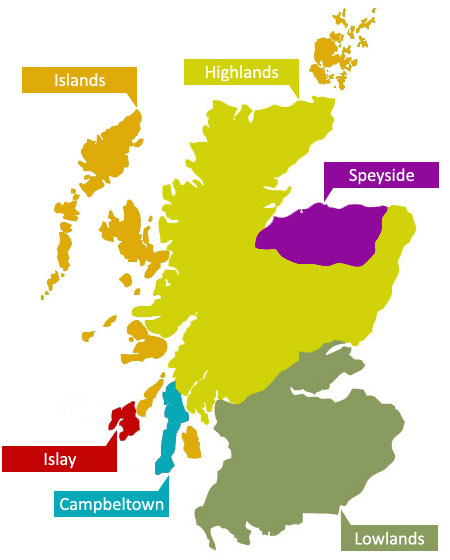
Scotch whiskey production is broken down into 6 regions. Highlands, Speyside, Lowlands, Campbeltown, Islay, and the Islands. The islands are something of a new designation but are widely accepted to be a distinct region. 

The Highlands is the largest region and thus the most diverse. It has over 25 distilleries, the most famous being Glenmorangie and Dalmore. Some people even divide the highland region into north, south, east, and west. The north has more full-bodied whiskies, lighter fruitier styles are found in the east and south. the west is a bit bigger and peatier with more coastal influences. It's hard to draw an accurate determination of taste if a whisky just says highlands. 

The Speyside region, while smaller than the highlands, has over 60 distilleries. The most famous being Macallan, Glenlivet, and Glenfiddich. Typically they are a bit softer and sweeter with little to no smokey peat flavor. Some can even bear a light salty flavor depending on their proximity to the coast. Over 60% of single malt scotch comes from this relatively small area

The Lowlands are the second biggest region, but only houses 5 distilleries, the most famous being Auchentoshan. These whiskies also tend to be lighter, with no peatiness and are occasionally triple distilled. They sometimes have a grassy or honeysuckle note.

Campbeltown is one of the most historic regions but is now down to just 3 distilleries. This region's whiskies are dry, briny, and sometimes pungent but can be fuller or lighter in body. Springbank is probably the best-known brand.

Islay (pronounced eye-luh) is the smallest region but probably the most famous and most beautiful. Housing less than 10 distilleries, this area produces peaty smokey single malts like Ardbeg, Laphroaig, and Lagavulin. They often bring notes of smoked fish or seaweed. These whiskies are often too aggressive for beginner scotch drinkers.

The Islands are not recognized by the Scotch Whisky Association but are widely agreed to be their own region. They are naturally very varied in style and taste. There are over 800 islands off the coast of Scotland but very few are inhabited. Some of the most famous island whiskies are Highland Park from Orkney and Talisker coming from the Isle of Skye.

"I love too sing, and I love to drink scotch. Most people would rather hear me drink scotch."
- George Burns

Sunday, August 2, 2015

Whiskey 401: Dissecting a cocktail: The Whiskey sour

The drink known as the Sour has gone through countless iterations over the centuries. I thought of organizing this by time period, instead I opted to go simply by the level of complexity and adding a few variants once the foundation has been laid. The Sour has gone through so many modifications and iterations it's near impossible to pinpoint a date when the trends changed. The origins of the sour as an individual cocktail and not a punch probably started around the 1850's. This was most likely done by sailors drinking rum while trying to fight scurvy with citrus juice and adding sugar to make the drink taste good. It was certainly after World War II, in the 60's, when store-bought sour mix became widely popular. Eventually, it even made its way onto some of our soda guns. In the nineties bartenders started exploring the idea of fresh ingredients once again. 

Modern
The first recipe I ever learned was 1 oz Whiskey and 2 oz of Sour Mix. This was shaken and served in a rocks glass with ice. It was mentioned that this could be served up, but most people took it on the rocks. Most people I saw wouldn't even really shake this, especially if it was going on the rocks. They'd just give it one or two shakes and dump it in.  They thought that shaking was to chill a drink. No, it's to blend the ingredients and to incorporate air, adding texture. To cite a blog that helped inspire me to start this, Death to Sour Mix. Assuming you use a prepackaged store-bought sour mix, this should just be called a sour, as you can't taste or appreciate whatever liquor is in the drink. The chemicals and sugar content in that mix just destroys the integrity of the other ingredients. I did learn how to make a simple sour mix however and that's where we get into the real recipe. 

Classic
This drink follows much more closely to the classic cocktail bars. I eventually learned a true recipe for this drink. It being 2 oz. Whiskey, 3/4 oz. Lemon Juice, and 3/4 oz. Simple Syrup. It's shaken good and hard, strained or double strained, and served up or on the rocks. This is an example of proper balance. A drink should have an equal balance of sweet and citrus. This while maintaining a respect for the alcohol makes a proper ratio of ingredients. This is a bit stronger than the standard drink ordered at the bar today. It's about twice the ABV of a whiskey ginger or similar highball. This is much more in line with cocktails and less focused on speed of production. Store bought sour mix was created to increase the speed of drink production and to eliminate a lot of the prep work that would need to be done every day, namely squeezing fruit and making syrups. But losing the craft means losing the character of a drink.

Traditional
This drink took a little adjusting to when I first heard about. It took a bit of a leap in order to try it, but to my amazement, it was really good. To this day, there are very few Americans that know about using egg white in cocktails. People think that the drink will taste like breakfast or egg nog. Neither is true nor are you at all likely to get salmonella. So, what does the egg bring to the table? The proteins in the egg while unravel and create an amazing silky texture and decadent foamy cap. This kind of cocktail should use the same recipe as the Classic Sour but add the white of one egg, or about 1oz. of egg white. You can't just shake a drink with egg white normally though if you want the best consistency. You need to shake the drink without the ice first to blend the cocktail and open up the proteins. This is called dry shaking. Once you do that, you shake normally with ice to chill the drink and usually double strain into a sours or cocktail glass. Most people think that the beautiful foam that comes from using egg white is lost when the drink is served on the rocks, but it can be done. 

Other Great Variants
The Stone Sour is a very fun variation which uses orange juice as well as lemon and simple syrup. A Gold Rush uses honey instead of simple syrup. The New York Sour is one of those drinks that just keeps adding to a great drink. It's a classic or traditional whiskey sour served on the rock with a float of red wine. I always find this drink very odd when made with egg white and red wine floated on top of the foam. I prefer it made without the egg white and served on the rocks. The ice makes it much easier to float the red wine. I also find that a layered presentation works best with more cylindrical glasses, rather than martini glasses or coupes. There is also the Fix, which is just a sour made over crushed ice. A John Collins is just a tall whiskey sour topped with club soda. A Fizz is the same thing but also using egg white to create a very fluffy foam on top.

“Sometimes life is sad. You can cry in your booze if you want. I think that’s called a Whiskey Sour.”
- Jarod Kintz

Photo Credit: Wikimedia

Thursday, April 16, 2015

Tobacco and drinking

I'm going to open with a quote this time: "To be honest, after years of smoking & drinking, you do sometimes look at yourself & think... in between the first cigarette with coffee in the morning to that 400th glass of corner-shop piss at 3am, you do sometimes look at yourself & think: 'This is fantastic, I'm in heaven.'" A truly wonderful quote by Dylan Moran in Black Books. Guilty pleasures are what makes us so interesting. Hedonism, consciously unconscious self-destruction, cognitive dissonance, a glorious blend of yummy yummy and boo hoo, that's what smoking is. That's what drinking is. And it's so much better when they're combined together. Why is it that the things that feel best in the world always have those little strings attached.

Drinking and smoking have been entwined into our culture for a long time. From the upper-class ladies sipping a martini and smoking a long cigarette, to a tired politician smoking a cigar with a glass of whiskey or brandy. I'm sure a Budweiser can has been used as an ashtray many a time. It occurred almost simultaneously that we discovered that smoking was bad for us and that alcoholism was declared a disease, despite their massively extensive history. What is it about a slow release of poison into our system that is so fantastic?

Tobacco and drink have gone together a long time, so much so that many cigars are ever aged on old liquor barrels. I'm smoked a number of whiskey, rum, and brandy cigars, where the tobacco leaves are aged in the old wood. They take on the smell and some of the flavors on the spirit.

Tobacco liqueur does exist as well. It's a fairly new product. It takes fresh tobacco from Louisiana along the Missippi. It carries a great oily nature from the fresh tobacco leaves. Dried smoking tobacco has a much different nature than fresh of course. It was actually featured on Travel Channels Booze Traveler.

The cigar bar is an ancient institution. While they really only became truly popular as cigar bars in the nineties after the smoking bans. Before the bans, everyone smoked in bars. Some bars might've had no-smoking areas but it was just how it was done, going back to gentleman's clubs and hunting lodges and the like. Hookah bars have also started popping up in cities and small towns across the country. They take a good deal of their theme from Middle Eastern and Asian bars and cafes, though some are blending more into the gentleman's club vibe. Human beings seem to need an activity to occupy them while having meaningful conversations. They smoke, have a drink, or play a game of chess. Smoking and drinking in theory are individual actions but they bring about a great sense of community. I got one of my first jobs by having a conversation with a manager over a cigarette while he was on break. These days especially, smoking has become a community.

Aside from the glorious smokey flavor that ties tobacco with so many spirits and the great sense of community granted by both indulgences I really don't know what makes them so great together. But they are. 

"I know a man who gave up smoking, drinking, sex, and rich food. He was healthy right up to the day he killed himself."
- Johnny Carson

Photo Credit: Needpix, pikist

Wednesday, December 3, 2014

Whiskey 302: Let's try some Scotch Cocktails!

Scotch is a very fun spirit, but one that isn't played with quite enough. There are a few staples and simple cocktails, but scotch is typically just drunk straight. This appeals to some bartenders, however. When something hasn't been tinkered with and probed and prodded with it's a chance for a bartender to actually do something fun and unique.

Rob Roy

2oz. Scotch whisky, 3/4oz. Sweet vermouth, 2 dashes Angostura Bitters
Add all the ingredients to a mixing glass with ice. Stir the drink until chilled. Strain the drink into a cocktail glass. Garnish with a cherry
The Rob Roy in reality is just a Manhattan with scotch. which is partly what makes it such a good choice to be on my list of scotch cocktails. Some drinkers will also use orange bitters instead of Angostura. Others will use a twist of lemon or orange to garnish. The drink is named after a popular Scottish folk hero, Robert Roy Macgregor, a sort of Scottish Robin Hood, who was actually portrayed by Liam Neeson.

Godfather
1 1/2 oz. Scotch, 3/4 oz. Amaretto
In a rocks glass, add the scotch, and then the amaretto with ice. 
This drink has a fun history. The drink is named after the great film but did technically exist before that as a "scotch and amaretto". People found that the drink perfectly represented the film and the mafia. Scotch has always been based on a warrior culture. Amaretto is an Italian liquor that has strong ties to love and family. The warrior and the family man was what the godfather represented. It's also the combination of my two favorite sipping spirits. 

Blood and Sand
3/4oz. Scotch, 3/4oz. Sweet vermouth, 3/4oz. Cherry Heering, 3/4oz. OJ
In a mixing glass add the ingredients. Add ice and shake. Strain the contents into a cocktail glass. Garnish with an orange twist or cherry
The recipe for the Blood and Sand first appeared in print in Harry Craddock’s 1930 The Savoy Cocktail Book. It's actually a pretty unique combination of ingredients. 3 very different spirits and one juice in equal proportions form an odd blend of fruity and smokey. I will yield, the first time I tried this drink I didn't like it. There seemed to be too many elements that should've been in conflict. Mastery of this drink really does show a great deal of knowledge and balance on a bartender's part.

Sin Cyn
1 oz. Scotch, 1 oz. Cynar, 1 oz. Sweet Vermouth
Add all the ingredients to a mixing glass with ice. Stir the drink until well chilled. Strain the drink into a chilled cocktail glass. Garnish with a cherry.
This is a pretty modern drink you can find at the red owl tavern in Philadelphia. It's sort of a spin on the boulevardier, being bourbon, Campari, and sweet vermouth. This uses scotch instead of bourbon and Cynar instead of Campari. It's quite a similar cocktail but a bit less sweet from the tweaks. Cynar is also an Italian bitter liqueur, but with a prominent flavor of the artichoke. It is actually produced by the same company that makes Campari.

Special mention to: Penicillin, Rusty Nail, Presbyterian, The Modern

“Scotch whisky is made from barley and the morning dew on angel's nipples.”
- Warren Ellis

Photo Credit: Wikimedia, pikist

Friday, November 28, 2014

Ogre Killer

The name was inspired by the anime Yu Yu Hakusho. The character Chu, who practices suiken or drunken boxing, has a secret weapon. He pulls out a flask of what is called ogre killer, the strongest booze in Demon World. He chugs it down, and his skin changes color and he takes a fighting stance, not before immediately vomiting of course. The fight ends with a fabulous knife edge death match, where both fighters stand face to face with their back foot against a blade. They wail on each other in the manliest fashion continuously pressing the others foot into the blade. To any man who has ever enjoyed a fight, even when you lost, try this drink. It gives you very much the same feeling. 

1 oz. Everclear (190 proof)
1/2 oz. Joven Mezcal
1/2 oz. Scotch

Add all the ingredients to a rocks glass. Add ice. Stir with a knife. Leave the knife in to make it authentic. For this picture, I actually left the knife in the ice block mold as it froze. This was to make it more reminiscent of the show

Let's do the math on this drink.
(1oz * 190 proof) + (1/2oz * 80 proof) + (1/2oz * 80 proof) 
= 2oz of 135 proof
This drink is 68% alcohol before ice melt. It is the equivalent of 3.375 shots of 80 proof spirit. Do be careful in the partaking of beverage. It's one and done.

This drink was designed as a challenge for a friend of mine who claimed to have never gotten properly drunk no matter how much he drank. I made him one of these and he was drunk. I've had friends drink this and scream "That should not be legal!" The fun thing is that it isn't in many states. 190 proof Everclear is not for sale in 14 states: California, Florida, Hawaii, Iowa, Maine, Michigan, Maryland, Minnesota, Nevada, New Hampshire, North Carolina, Ohio, Virginia, and Washington. I could have certainly made a stronger drink, but I wanted something that had a little flavor to it. The pain of Everclear had to be there, but you can still enjoy it. As someone who once dated a dominatrix can tell you, a bit of pain is just part of the fun. 

Monday, November 17, 2014

Whiskey 301: Let's try some Whiskey Cocktails!

Now that we have a foundation of what whiskey is, how it's made, and how to appreciate it, it's time to use it. Whiskey is a key tool in any bartender's arsenal. These drinks are designed to showcase the whiskey so don't skimp too much. Bourbon is the staple for each of these, but you can use almost any North American whiskey for these.

Old Fashioned:
 

2 oz. Whiskey, 1 Sugar Cube, Angostura Bitters, Orange Twist
Soak the sugar cube in bitters. Place the cube in a rocks glass and muddle it with a little water or club soda. Add ice to the glass and then add some whiskey, typically bourbon. Stir lightly and garnish it all with an orange peel.
Where better to start drinking cocktails than with a classic that remains great to this day? Also known as the old fashioned whiskey cocktail. This drink dates back a very long time. Most likely, the origins of this drink go back to the 1700's. All a cocktail was historically was a spirit with sugar and bitters. The old fashioned holds true to this and just throws a little garnish in there. The garnish of an old fashioned is very up to debate. An orange slice, orange peel, lemon peel, a cherry, or a combination thereof are all commonly used.

Manhattan:
2 oz. Whiskey, 1 oz. Sweet Vermouth, 2 Dashes Bitters, Cherry
In a mixing glass add all the ingredients. Add ice and stir the drink until it is well chilled. Strain the drink into a chilled cocktail glass and garnish with a cherry.
The Manhattan is a more modern retelling of what the old fashioned was. Instead of using regular sugar, however, one uses sweet vermouth. The origins are a bit shady and there are many myths behind it, many of them were disproved. This was invented in the late 1800's or the early 1900's. Thus, the original recipe is a bit hazy as well. These days craft bartenders make their Manhattans with a ratio of 2:1:2. Possibly coincidentally, 212 is the area code of Manhattan, New York. 

Mint Julep:
2 ½ oz. Bourbon, 1 oz. Simple Syrup, 2-4 Mint Sprigs
Lightly muddle 5 or 6 mint leaves with the simple syrup in a julep cup. Add about an ounce of bourbon to the cup and then fill with crushed ice. lightly stir the drink and add the remaining bourbon and a bit more ice for presentation. Stir again and garnish with a sprig of mint. 
The Mint Julep is actually the Mint Sling. First recorded in 1793, the original recipe did call for cognac rather than bourbon. This is one of the staple drinks of the Kentucky Derby. The immense cold of this drink and the nice sweet notes of the sugar, as well as the oils of the mint, create an amazing refreshing beverage for a hot day that doesn't skimp on the whiskey.

Whiskey Sour:

1 ½ oz. whiskey, ¾ oz. simple syrup, ¾ oz. lemon juice,
Shake all the ingredients with ice in a shaker and strain either into a rocks glass with ice or a sours glass. Garnish with an orange slice and a cherry
The whiskey sour came about between 1850 and 1860. This is a playground for bartenders. Try it with a little orange juice for a Stone Sour. Float some red wine on top for a New York Sour. Change the glass and add a little soda on top and you get a John Collins. Different places will change the ratio of whiskey to sour mix. 

Special mention to: the Highball, John Collins, Jack and Coke, and Sazerac

"Give an Irishman lager for a month and he's a dead man. An Irishman's stomach is lined with copper, and the beer corrodes it. But whiskey polishes the copper and is the saving of him." 
-Mark Twain

Photo Credit: Wikimedia

Sunday, November 9, 2014

Beginner's Flight: Whiskey

This is going to be a series of posts about how to start sampling different types of spirits if you are a beginner drinker. What's the difference between bourbon, scotch, and Irish whiskey. How is London dry gin different from American or Indian made gin? The best way to figure out what you like is to go out and try things. With so many options out there I thought it would be nice to give newbies a jumping-off point into their world of spirits. These will be fairly medium-priced spirits. I mean these lists to be accessible so probably nothing more than about $30 a bottle, that said, there's no reason for anyone to buy a $6 handle of Vlad vodka and drink it straight. First, I'm talking whiskey.

I think the ideal beginner's flight of whiskey should be one from around the globe. These are the staple whiskeys and they will give a well-rounded view as to the style of each region. When trying a whiskey sample it neat then try it again with a few drops of water added to it. This opens up the aroma and releases some of the oils that may have been hiding.

1. Makers Mark Bourbon. 
I describe this as a staple bourbon. They spell it "whisky" instead of "whiskey" because they feel it is of a caliber high enough to compete with any old world whisky. Made with corn is has a smooth sweetness to it. The bite is there, but it won't kill any rookie. This is great to sip or in any whiskey prominent cocktails, like Manhattans and Old Fashioneds.

2. Jameson Irish Whiskey. 
This Irish whiskey is known around the world. Jameson is always the starting drink of a night of binge drinking. Irish whiskey is commonly seen as the lightest style of whiskey because it really doesn't use any smoke in its process. College students regularly drink half a bottle of this or more by themselves in one night. Just remember, just because it flows down your throat like water does not mean that your body can handle it like water.

3. The Famous Grouse Scotch. 
Famous grouse is the highest-selling scotch of Scotland for the last 30+ years. It is a blend rather than a single malt, but it does an excellent job of conveying quality and authenticity. The whiskeys used in the blend come from Highland Park and Macallan, two very fine scotch brands. (Hi Jason, thanks again for all the tastings)

4. Bulleit Rye. 
Yes, another American company pops onto the list. I thought of doing a Canadian whiskey, but they tend to work in rye these days. Bulleit is 95% rye in the mash. Rye whiskeys are often seen to have a spicy flavor to them. not really a jalapeno spice, more of baking spice.
special mention to: Booker's bourbon, Jack Daniels, Crown Royal, Southern Comfort, and any and all moonshine

Aye, but today's rain is tomorrow's whiskey.
- Scottish Proverb

Photo Credit: Pixabay, wikimedia


Monday, October 20, 2014

Whiskey 101: What's the difference?

I have a number of students coming to me having no idea what whiskey is or knowing anything about the spirit. Whiskey is simply a grain-based spirit that has been distilled and aged. What make whiskey so special is the versatility of the simplicity. Most would categorize whiskey based on the region it comes from. This is a very good start, but you must keep in mind that each region has their own laws and standards of how their whiskey must be made in order to qualify for their moniker. The biggest whiskeys / whiskys are Scotch whisky, Bourbon whiskey, and Irish whiskey. There is also, Canadian whisky, Japanese whisky, Tennessee whiskey, and even French and Italian whisky. There are many subsets in each of the broad categories, but that'll be in my Whiskey 201 post(s).
Scotch Whisky has to naturally come from Scotland. Globally, it is the best selling style of whiskey or whisky despite its relatively small geography to work with. For the record, whiskey and whisky are the exact same thing, it's just that different nations and companies have chosen to spell it one way or another. Given the small region and strict laws, scotch is a very consistently excellent product. Scotch must be made with barley as the main grain in the mash. Scotch must also be aged at least 3 years in oak barrels. Finally, scotch must be at least 40% alcohol (80 proof) though it can technically go up to 94.8%.

Bourbon Whiskey has to be made in the United States of America. Contrary to popular belief it does not have to be made in Bourbon, Kentucky. The dominant mash of bourbon must be corn. corn is a sweeter grain compared to barley so many bourbons are often regarded as sweet whiskeys. A fairly unique thing about bourbon is that it can only be aged in fresh, unused, charred, oak barrels. Bourbon does not have a required duration for its age though any straight bourbon must be aged at least 2 years. Many modern scotch companies actually use old recycled bourbon barrels or sherry barrels. Bourbon again can't be sold at less than 40% but does have an upper limit of 63%.

Irish whiskey must, naturally, come from Ireland. Most Irish whiskey is distilled three times compared to the two times for most other styles of whiskey. The amazing thing is that only 7 Irish whiskey distilleries exist compared to some 105 Scottish distilleries. Irish whiskey has very much the same laws affecting it as scotch. Irish whiskey must be aged at least 3 years in wood casks, and be no more than 94.8% alcohol. Due to the water sources and how the grains are cooked and distilled, Irish whiskey is seen as was of the smoothest, lightest, on the market and is fantastic for beginner drinkers of straight whiskey. Because of this, Irish whiskey has become the largest growing section of the whiskey community.

Tennessee is just a straight bourbon type whiskey made in Tennessee. Canadian whiskey has to come from Canada and has laxly the same regulation as the other big name whiskeys. Japanese, French, and Italian whiskeys naturally come from their respective countries. It is worth mentioning that there a number of other terms used in classifying whiskeys such as single malt vs blended whiskies, rye whiskey, and flavored whiskies.

“Love makes the world go round? Not at all. Whiskey makes it go round twice as fast.”
- Compton Mackenzie

Photo Credit: Wikimedia, pikist